

On July 28, 2025, the Indian share market declined for the third straight session. The fall was led by heavy selling in banking and IT stocks, FII outflows, and concerns over the India-U.S. trade deal. Rising crude oil prices and weak industrial data added to the pressure. However, DII buying limited deeper losses. The decline reflected a mix of global and domestic factors rather than any single trigger. Let’s Decode Share Market Update 28 July: Why Did the Market Fall?
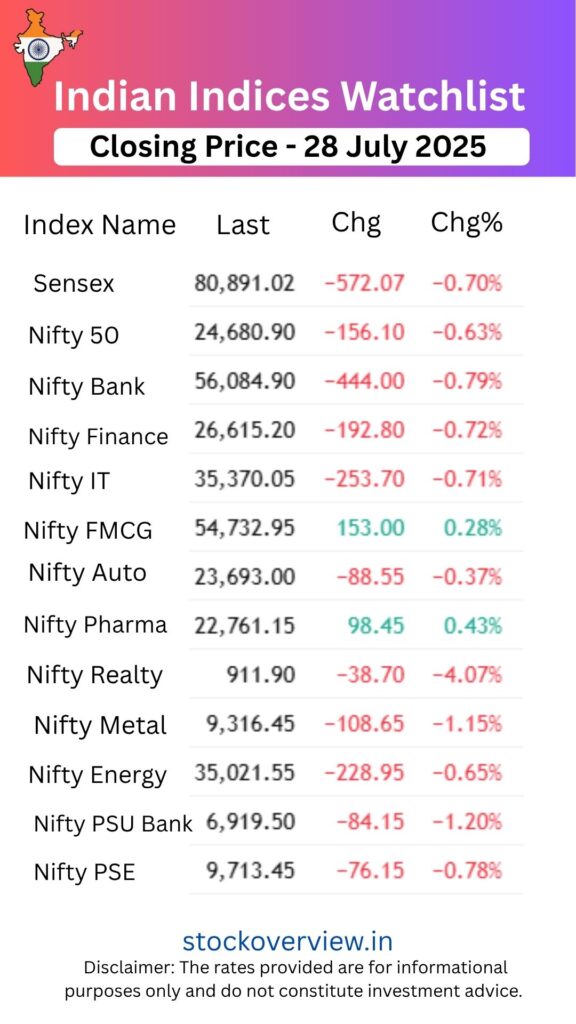
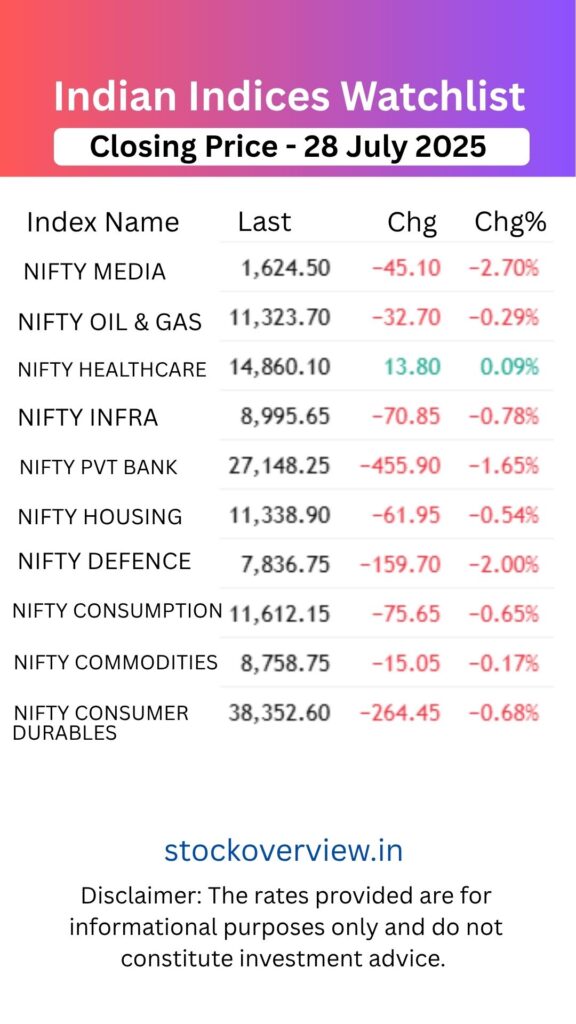
Based on the “Indian Indices Watchlist – Closing Price – 28 July 2025”
Top Gainers (by Chg%)
- NIFTY PHARMA: +0.43%
- NIFTY FMCG: +0.28%
- NIFTY HEALTHCARE: +0.09%
Top Losers (by Chg%)
- Nifty Realty: -4.07%
- NIFTY DEFENCE: -2.00%
- NIFTY PVT BANK: -1.65%
FII/FPI & DII Trading Activity in Capital Market Segment

Domestic Institutional Investors (DIIs) showed a net buying activity, with a buy value of ₹15,799.53 Crores and a sell value of ₹9,034.98 Crores, resulting in a positive net value of ₹6,764.55 Crores.
Foreign Institutional Investors/Foreign Portfolio Investors (FII/FPIs), on the other hand, were net sellers. Their buy value stood at ₹9,993.78 Crores, while their sell value was significantly higher at ₹16,076.25 Crores, leading to a negative net value of -₹6,082.47 Crores.
Delay in India-U.S. trade deal weighs on market sentiment.
Uncertainty around the India-U.S. trade deal triggered investor concerns. This ambiguity led to increased selling pressure in the market.

Donald Trump’s self-imposed August 1 tariff deadline created significant market uncertainty and investor concern regarding potential trade disruptions for countries without a deal.
India is adopting a cautious approach in trade negotiations, prioritizing national interests over deadlines, influenced by complications seen in recent US agreements with other nations.
Despite India’s caution, the US reiterated August 1 as a final deadline for tariffs with no extensions, maintaining pressure.
The ongoing uncertainty, amplified by the looming deadline and India’s measured stance, is generating a “geopolitical risk premium” in the market, discouraging fresh foreign investment and encouraging domestic caution.
This prolonged ambiguity regarding the trade deal’s terms and finalization is a significant deterrent for both foreign and domestic capital, impacting future economic and corporate earnings predictability.
Crude oil prices-28 JULY 2025
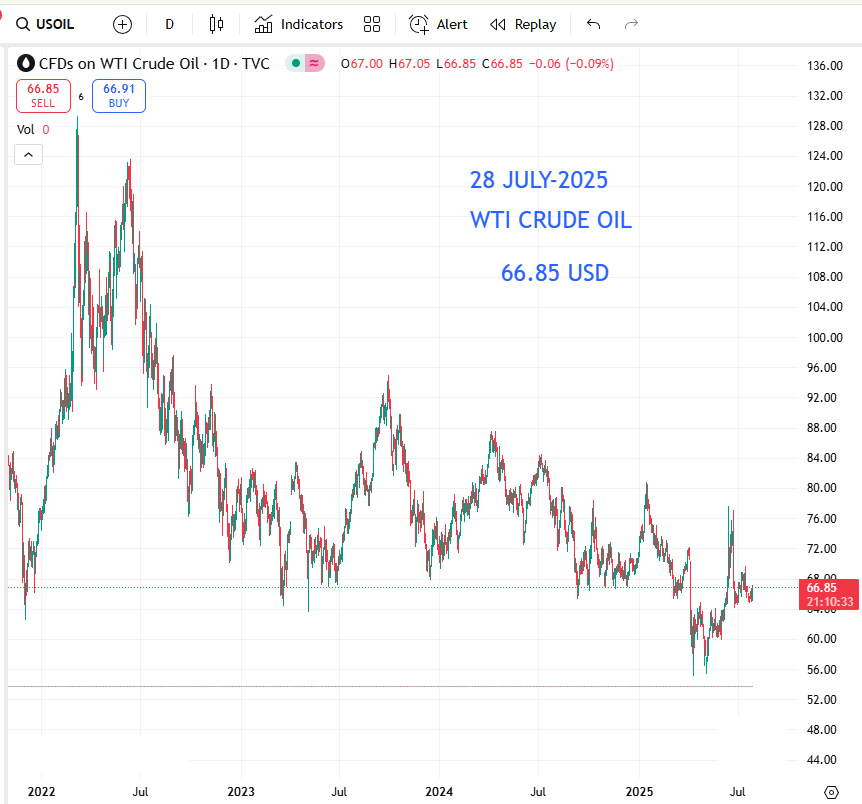
WTI Crude Oil is priced at $66.85 per barrel.
It has fallen significantly from the $120 peak in March 2022.
Since early 2024, the trend shows consolidation with a slight decline.
However, in the weeks leading up to 28 July 2025, prices have started to rise.
So, in the short term, crude oil is getting expensive again.
Weak cues from Japan’s Nikkei 225 contributed to Indian investor caution despite mixed performances across other Asian and US markets.
A significant surge in global crude oil prices, with Brent crude nearing $70 a barrel, heightened inflationary concerns for oil-importing India.
The strengthening U.S. dollar index (rising 1.1% to 98.67) intensified pressure by making imports, including crude oil, more expensive and reducing the attractiveness of Indian assets for foreign investors.
The combination of rising crude oil prices and a strengthening US dollar creates a compounding negative effect, exacerbating inflationary fears and encouraging FII outflows from India.
These specific commodity and currency movements created significant macroeconomic headwinds for the Indian market, making it susceptible to external shocks despite varied global equity performances.
Weak industrial data
The latest industrial production (IIP) data came in weaker than expected, dampening market sentiment.
Weak factory output signals a slowdown in economic activity.
This raises concerns over future corporate earnings and weakens investor confidence.
As a result, selling pressure intensified in the stock market.
Market Performance : July 28, 2025
The Indian equity market declined for the third straight session, with both Sensex and Nifty closing lower amid widespread bearish sentiment.
- Sensex fell 572.07 points (-0.70%) to 80,891.02
- Nifty 50 declined 156.10 points (-0.63%) to 24,680.90
- Mid-cap index dropped 0.8%
- Small-cap index lost 1.3%
- India VIX surged by 7%, reflecting rising market volatility
Other Notable Corporate Developments (Contextual Impact)
This broad-based sell-off and rising volatility signal deepening investor caution and expectations of further downside unless a strong positive trigger emerges.
Despite a broader market downturn, individual corporate developments presented a mixed picture, showing selective market responses.
Adani Green Energy and Waaree Energies reported robust Q1 net profit surges of 31% and 89% respectively, showcasing strong individual performance.
Kamat Hotels expanded its portfolio by signing a management agreement for a second Orchid Hotel in Nashik, indicating growth in the hospitality sector.
Sona Comstar addressed governance concerns with a clarification emphasizing an independent board, aiming to boost investor confidence.
Indian automobile stocks like Tata Motors and Sona BLW gained up to 2% due to positive sentiment from a new US-EU trade deal easing tariffs.
Conversely, Adani Total Gas (ATGL) experienced a 4% fall in Q1 consolidated net profit.
Havix Group received three 483 observations from a USFDA inspection, signaling potential regulatory compliance challenges.
Indian Energy Exchange (IEX) shares plunged 8% on July 28, contributing to a nearly 30% fall over five sessions, despite strong Q1 financial results.
IEX’s significant decline was primarily driven by the CERC’s Market Coupling Plan, illustrating how regulatory changes can override positive fundamentals.
The market’s nuanced response, with some stocks gaining and others falling sharply despite good earnings, indicates that fundamental, sentiment, and regulatory factors are all at play, with regulatory risk notably impacting IEX.
Analyst Perspectives and Market Outlook
Leading analysts attributed the July 28 market fall to heavy selling in banking stocks, weak Asian cues, and rising Brent crude prices.
Persistent FII selloff and a lack of significant positive Q1 earnings surprises were also cited as key reasons for the downturn.
Factors like a strengthening US dollar, expectations of a Fed rate cut, and the absence of major trade deals impacted FII sentiment.
The IT sector continues to struggle due to muted discretionary spending and weak client budgets, particularly in the US.
Despite poor H1 2025 performance, some experts view the IT sector’s correction as a long-term buying opportunity given its strong fundamentals and potential for recovery with global growth stabilization.
Crucially, consistent buying by Domestic Institutional Investors (DIIs) is providing significant support to the market amidst FII outflows.
Analysts generally agree that strong domestic fundamentals and DII support are preventing a sharp, sustained correction from FII selling alone.
The Nifty index is anticipated to enter a consolidation zone, with crucial support identified around the 100-day EMA zone of 24600-24550.
A sustainable move below 24550 could signal further correction for the Nifty, while 25100-25150 acts as a key resistance level.
The Bank Nifty, despite outperforming, faces resistance around 57300-57400, and a Gravestone Doji on its weekly chart suggests near-term indecision and potential reversal.
Conclusion & Market Outlook
The July 28 market decline stemmed from a mix of sectoral weaknesses (notably in banking and IT), persistent FII outflows, and rising macroeconomic concerns like crude oil prices and trade deal uncertainty with the U.S. Kotak Bank’s operational stress and global IT demand slowdown further added to pressure.
However, strong DII buying and supportive RBI policies offered some stability.
Looking ahead, key drivers will include the outcome of India-U.S. trade talks, FII activity trends, corporate earnings (especially in banking & IT), and global crude prices. Market direction will likely remain sensitive to both domestic signals and global cues in the near term.
Is crude oil becoming expensive now?
Yes, crude oil is getting expensive again in the recent short-term trend.
What does the overall trend show – decline or rise?
Long-term trend shows a decline, but recent trend shows a slight rise.
Disclaimer:
All content shared by STOCK OVERVIEW is purely for educational and informational purposes only. We do not provide any investment advice or stock recommendations. Please consult a SEBI-registered financial advisor before making any trading or investment decisions. This content is created solely to help and guide you with market awareness. STOCK OVERVIEW will not be held responsible for any financial gains or losses arising from the use of this information.

Welcome to Stock Overview! Expand your knowledge about the stock market and invest smarter. I started this channel to help everyone understand the basics of the stock market. When you meet a SEBI-registered advisor or a mutual fund distributor, you should be able to understand their suggestions clearly. This is only possible when you’ve done your minimum homework from your side. My goal is to empower you to make informed financial decisions confidently.
Contents
- 1 FII/FPI & DII Trading Activity in Capital Market Segment
- 2 Delay in India-U.S. trade deal weighs on market sentiment.
- 3 Crude oil prices-28 JULY 2025
- 4 Weak industrial data
- 5 Market Performance : July 28, 2025
- 6 Other Notable Corporate Developments (Contextual Impact)
- 7 Analyst Perspectives and Market Outlook
- 8 Conclusion & Market Outlook