

Welcome to the Indian Indices Closing Price Update. On July 31, the market closed with some volatility. Let’s Decode Top Gainers and Losers 31 July 2025
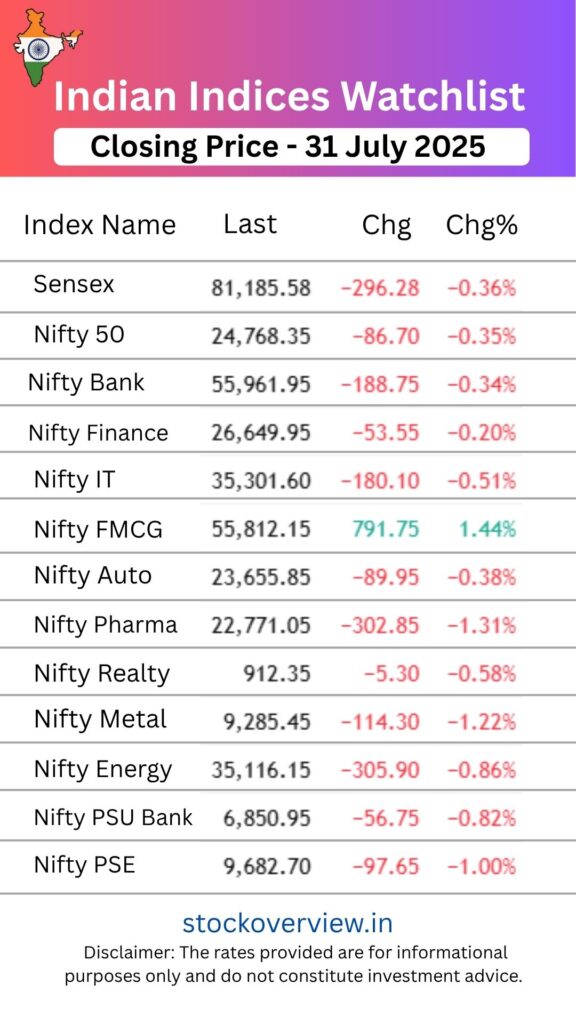
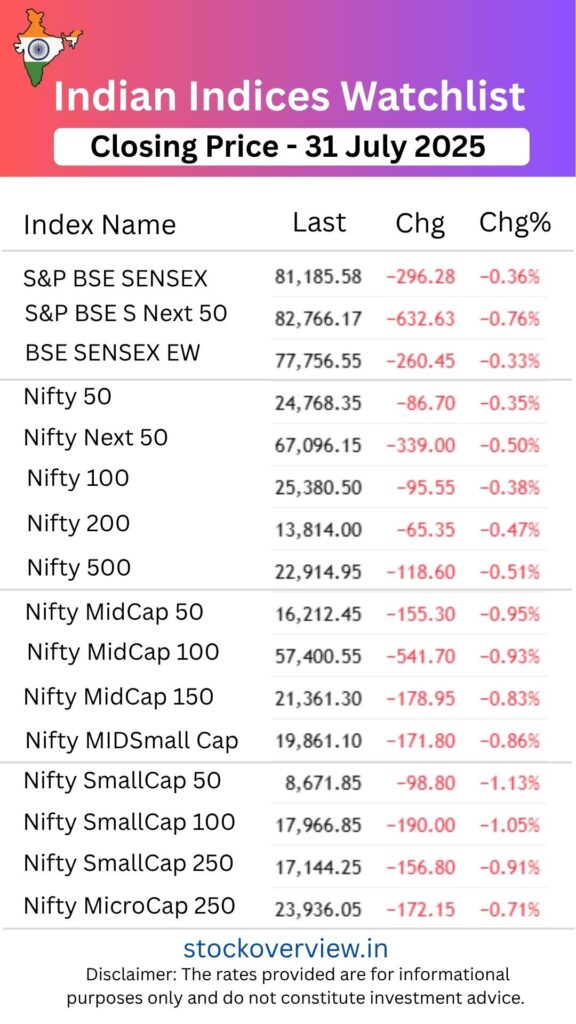
Market Highlights – Major Indices Performance: Sensex closed at 81,185.58, down by 296.28 points, registering a 0.36% decline. Nifty 50 ended the day at 24,768.35, falling by 86.70 points, a drop of 0.35%. Bank Nifty also witnessed a fall of 188.75 points, closing at 55,961.95. Nifty Next 50 slipped 339.00 points to settle at 67,096.15.
Main Indices Performance -Top Gainers and Losers 31 July 2025
Main Indices Performance -Top Gainers and Losers 31 July 2025
Main Indices Performance -Top Gainers and Losers 31 July 2025
Main Indices Performance
Top Gainers- Top Gainers and Losers 31 July 2025
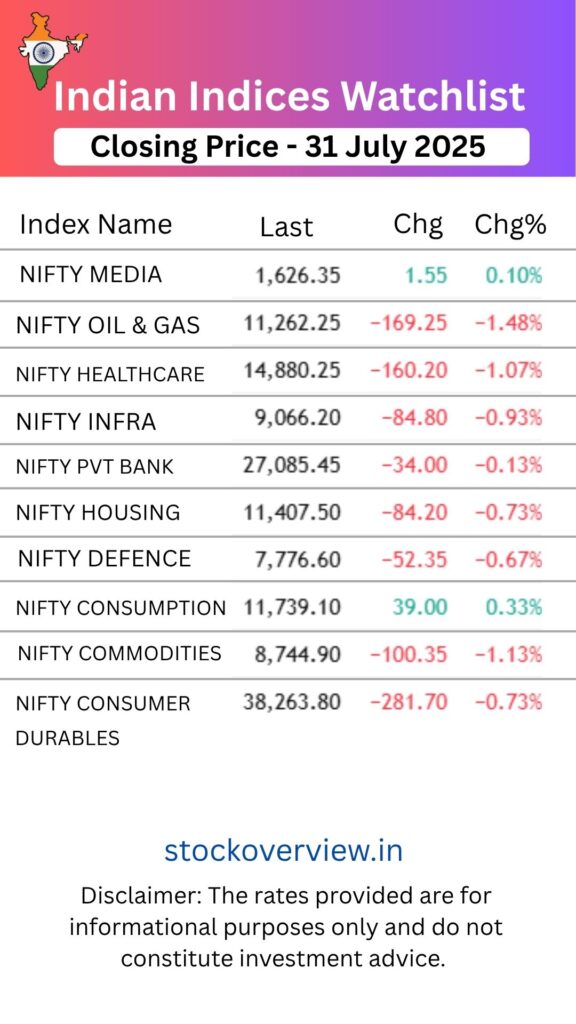
On the sectoral front, Nifty FMCG emerged as the top performer of the day, registering a sharp gain of 791.75 points to close at 55,812.15, reflecting a 1.44% rise.
Nifty Media ended marginally higher by 1.55 points, settling at 1,626.35. Meanwhile, Nifty Consumption advanced by 39.00 points, closing at 11,739.10, up 0.33%.
| Index | Closing | Change (%) |
|---|---|---|
| Nifty FMCG | 55,812.15 | +1.44% |
| Nifty Consumption | 11,739.10 | +0.33% |
| Nifty Media | 1,626.35 | +0.10% |
Top losers – Top Gainers and Losers 31 July 2025
On the flip side, sectoral losers were led by Nifty Pharma, which declined by 302.85 points to close at 22,771.05, marking a drop of 1.31%. Nifty Metal also ended lower, shedding 114.30 points to settle at 9,285.45. Other key indices including Nifty Energy, Nifty IT, and Nifty PSU Bank also witnessed negative traction, contributing to the overall subdued sectoral performance.
| Index | Closing | Change (%) |
|---|---|---|
| Nifty Oil & Gas | 11,262.25 | -1.48% |
| Nifty Pharma | 22,771.05 | -1.31% |
| Nifty Metal | 9,285.45 | -1.22% |
| Nifty Healthcare | 14,880.25 | -1.07% |
| Nifty SmallCap 100 | 17,966.85 | -1.05% |
In the broader markets, the Nifty Midcap 50 index slipped by 155.30 points to close at 16,212.45. The Nifty Midcap 100 also ended in the red, falling 541.70 points, while the Nifty Smallcap 100 declined by 190.00 points, reflecting overall weakness in the mid and small-cap segments.
We strongly urge you to trust charts and data-driven insights—don’t risk your capital based on hearsay. Stay informed, stay empowered.
On 31st July 2025, the Indian stock market remained under selling pressure with a majority of indices closing lower. FMCG and Consumption sectors offered some relief with strong gains, while Oil & Gas, Pharma, and Metal sectors dragged the market down. Investors are advised to stay cautious and watch global cues.
Why Sector Analysis is Important – Top 10 Reasons:
- To Track Capital Flow
– Smart money (FII/DII) flows into sectors that show strong growth potential. Sector analysis helps you identify where the money is going. - To Understand Market Trends
– Sometimes the overall market trend is driven by a few sectors. Analyzing sectors gives deeper insight into broader market movement. - For Better Stock Selection
– A good stock in a weak sector may underperform, while an average stock in a strong sector can deliver better returns. - To Build a Diversified Portfolio
– Sector-wise diversification reduces risk and balances returns, especially during volatile markets. - To Align with the Economic Cycle
– Every sector performs differently during various phases of the economic cycle. For example, Pharma and FMCG perform well during slowdowns, while Auto and Infra thrive in booms. - To Measure Risk and Volatility
– Some sectors are inherently riskier (like IT or Small-cap Tech), while others are more stable (like FMCG, Utilities). Sector analysis helps manage risk. - To Make Smart Earnings Season Decisions
– Sector-wise earnings performance gives early clues about which industries may lead or lag. This supports short-term trading and long-term investing. - To Evaluate Policy and Budget Impact
– Government policies, tax changes, or Budget announcements impact sectors differently. Sector analysis helps in assessing such changes. - To Use Sector Rotation Strategy
– Investors rotate funds between sectors depending on performance. Identifying early signs of sector rotation can help you switch in time. - To Assess Global & Macro Impacts
– Rising crude oil, interest rate hikes, or geopolitical tensions affect specific sectors (like Oil & Gas, Banks, or IT). Sector analysis helps you stay prepared.
Why do experts say “Don’t invest based on someone’s words”?
Because every investor has different risk capacity and financial goals. What worked for one may not work for another. Blindly trusting someone’s advice without your own analysis can lead to huge capital losses.
What is a data-driven investment approach?
A data-driven approach involves using tools like TradingView charts, Nifty sector analysis, FII/DII activity, and company earnings reports to make well-informed investment decisions. This method ensures transparency, logic, and lower risk.
How does data help in stock market investment?
Data helps investors track market behavior, evaluate company fundamentals, and identify entry or exit points. It builds confidence and reduces emotional trading, which is essential for long-term success in the stock market.
What is the risk of following stock tips without charts?
Following stock tips without verifying through technical charts or financial data is risky. Such tips may be biased, outdated, or false. Charts reveal support-resistance levels, volume trends, and momentum, helping you make informed decisions.
Read More
IRFC Share Price Target Analysis & Outlook (2025–2030)
LIC Share Price target Analysis 2025: Should You Invest Now or Wait?
Yes Bank and SMBC Deal 2025: Profits, Stake and Future Plans
Disclaimer:
All content shared by STOCK OVERVIEW is purely for educational and informational purposes only. We do not provide any investment advice or stock recommendations. Please consult a SEBI-registered financial advisor before making any trading or investment decisions. This content is created solely to help and guide you with market awareness. STOCK OVERVIEW will not be held responsible for any financial gains or losses arising from the use of this information.

Welcome to Stock Overview! Expand your knowledge about the stock market and invest smarter. I started this channel to help everyone understand the basics of the stock market. When you meet a SEBI-registered advisor or a mutual fund distributor, you should be able to understand their suggestions clearly. This is only possible when you’ve done your minimum homework from your side. My goal is to empower you to make informed financial decisions confidently.
Contents
- 1 Main Indices Performance -Top Gainers and Losers 31 July 2025
- 2 Main Indices Performance -Top Gainers and Losers 31 July 2025
- 3 Main Indices Performance -Top Gainers and Losers 31 July 2025
- 4 Top Gainers- Top Gainers and Losers 31 July 2025
- 5 Top losers – Top Gainers and Losers 31 July 2025
- 6 Why Sector Analysis is Important – Top 10 Reasons: