

Let’s find out what FIIs and DIIs are trading these days…
Welcome to Stock Overview!
Click here to watch the full video
Latest FII and DII Data Analysis (25 August 2025)
These days, the market is showing a clear pattern…
FIIs, the Foreign Institutional Investors, are in selling mode.
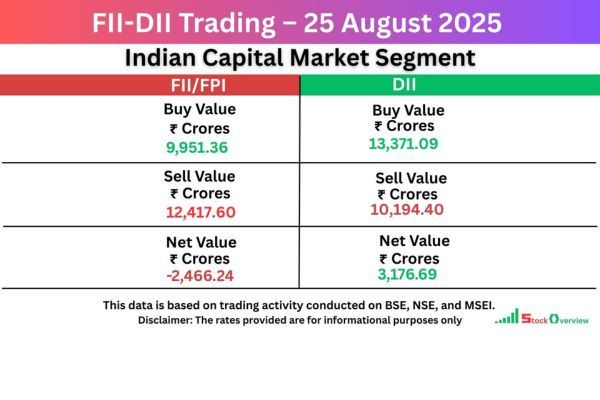
On 25th August, they bought around ₹9,951 crores, but sold ₹12,417 crores – taking out a net of ₹2,466 crores from the market.
On the other hand, DIIs, the Domestic Institutional Investors, are supporting the market.
They bought ₹13,371 crores and sold only ₹10,194 crores, resulting in a strong net inflow of ₹3,176 crores.
In simple words – FIIs are pulling money out, while DIIs are stepping in to balance the market.
The big question is – who will dominate in the coming days: the FII selling pressure or the DII buying support?
FII (Foreign Institutional Investors) selling pressure can happen for several reasons:
- Global Economic Uncertainty
- If global markets (like the US, Europe, China) face uncertainty — e.g., interest rate hikes, recession fears, or geopolitical tensions — FIIs may pull out money from India to reduce risk.
- Dollar Strength / Rupee Weakness
- When the USD strengthens and INR weakens, FIIs may face losses when converting their investments back to foreign currency, so they sell to avoid that.
- Domestic Factors
- High Inflation / Rising Interest Rates: RBI tightening makes equities less attractive.
- Weak Corporate Earnings: Poor quarterly results from companies can trigger FII selling.
- Profit Booking
- After good market performance in previous months, FIIs may sell to book profits.
- Sector/Stock-Specific Reasons
- FIIs may sell selectively if certain sectors (Banking, IT, Pharma) show weakness.
- Liquidity Needs / Portfolio Rebalancing
- FIIs often adjust their global portfolios, shifting money from equities to debt or other markets.
FII selling isn’t always negative; sometimes it’s just portfolio rebalancing or a reaction to global uncertainty. But if selling continues and domestic factors are weak, it can create short-term pressure in the market.
FII and DII Activity Summary (August 2025)
- FII Net Selling: FIIs have sold equities worth approximately ₹28,217 crore in August, bringing the total for the year to about ₹1.57 lakh crore.
- DII Net Buying: DIIs have been net buyers, with inflows of around ₹69,360 crore in August, indicating strong domestic support for the market.
Sector-wise FII Activity
- Financial Services & IT: These sectors have experienced the most significant outflows, with FIIs pulling out approximately ₹31,889 crore in early August.
- IT Sector: FIIs have sold over ₹50,000 crore worth of IT stocks in 2025, contributing to a 25% decline in the Nifty IT index, making it the worst-performing sector.
Global Factors Influencing FII Behavior
- US Tariffs: The U.S. administration’s decision to impose 50% tariffs on Indian goods starting August 27 has added to investor concerns.
- Currency Fluctuations: A weakening rupee has impacted returns for FIIs, prompting them to reassess their positions in the Indian market.
- Global Market Shifts: FIIs are redirecting investments to markets like South Korea and Taiwan, which are perceived to offer better growth potential.
Market Outlook
- DII Support: Domestic investors continue to show resilience, with consistent net buying, which may help stabilize the market.
- Potential Rebound: Analysts suggest that the current sell-off may present opportunities for long-term investors, especially in sectors like capital goods, automobiles, and healthcare.
In short, FII selling is driven by a combination of global uncertainties, currency fluctuations, and profit booking. However, consistent DII buying provides some market stability. Investors should monitor sector-specific trends and global economic developments while considering long-term investment opportunities.
Disclaimer
This article is for information and educational purposes only. The data on FII and DII activity, market trends, and sector analysis has been compiled from reliable sources, but it should not be considered as investment advice. Stock market investments are subject to market risks. Readers are advised to consult with a certified financial advisor before making any investment decisions. The author and publisher are not responsible for any financial loss arising from the use of this information.

Welcome to Stock Overview! Expand your knowledge about the stock market and invest smarter. I started this channel to help everyone understand the basics of the stock market. When you meet a SEBI-registered advisor or a mutual fund distributor, you should be able to understand their suggestions clearly. This is only possible when you’ve done your minimum homework from your side. My goal is to empower you to make informed financial decisions confidently.