

LIC is India’s oldest and most trusted life insurance company. It holds over 60% market share in the life insurance sector. LIC Share Price target Analysis 2025 Let’s Deep Dive into Growth, Valuation & Risks
LIC – Is It Just an Insurance Giant or a Golden Investment Opportunity?
Established in 1956, the Life Insurance Corporation of India (LIC) is not only the largest life insurance provider in the country but also a major player in India’s financial ecosystem. This government-owned entity manages over ₹40 lakh crore in Assets Under Management (AUM), making it one of the largest institutional investors in India.
In 2022, LIC launched its IPO and has since been listed on the stock exchanges. The big question now is:
Is investing in LIC a wise decision for long-term investors?
In this blog, we will dive deep into LIC’s fundamental analysis, technical position, and market valuation to help you decide whether this stock deserves a place in your portfolio.
Who Regulates LIC? Meet IRDAI – The Insurance Regulator of India
Just as the RBI regulates banks and SEBI oversees stock markets, the IRDAI (Insurance Regulatory and Development Authority of India) governs the insurance sector in India.
As India’s largest life insurer, LIC operates under the regulatory framework set by IRDAI, ensuring safety, transparency, and accountability for both investors and policyholders.
LIC’s Latest AUM
As per public disclosures:
₹44.34 lakh crore (as of March 2024)
This is the highest AUM held by any institutional investor in India.
What is AUM (Assets Under Management)?
AUM refers to the total amount of money that investors have entrusted to a mutual fund, PMS (Portfolio Management Service), or an AMC (Asset Management Company) for investment.
For example, if SBI Mutual Fund has an AUM of ₹10 lakh crore, it means they are managing and investing that amount on behalf of their investors.
A higher AUM indicates:
A wide range of funds and investment schemes under management
Greater trust and confidence from investors
What is Market Capitalization (Market Cap)?
According to the latest data from Screener.in, LIC commands a market capitalization of ₹6.03 lakh crore with a current stock price of ₹955 (as of May 30, 2025).
- Market Cap is the total value of a listed company in the stock market.
- Formula:
Market Cap = Share Price × Total Number of Shares - Example: If Reliance has 600 crore shares priced at ₹3,000 each,
→ Market Cap = ₹18 lakh crore.
A higher Market Cap indicates:
The company is large and well-established.
Strong presence and trust in the stock market.
Comparison: AUM vs Market Cap
| Points | AUM (Assets Under Management) | Market Cap (Market Capitalization) |
|---|---|---|
| What does it represent? | Total money collected from investors | Total value of a listed company in the stock market |
| Used for? | Mutual Funds, PMS, Asset Management Companies (AMCs) | Listed Companies (Stocks) |
| What does a higher value indicate? | More investor money is being managed | The company’s stock is valued higher |
| Investor trusts on? | Skill of the fund manager | Performance and fundamentals of the company |
LIC Fundamental Analysis Checklist (As of May 2025)
| Parameter | Observation |
|---|---|
| Market Cap | ₹6,03,784 Cr – One of India’s largest companies |
| AUM (Assets Under Management) | ₹44.34 Lakh Crore (as of March 2024) – India’s largest institutional investor |
| ROCE (Return on Capital Employed) | 53.5% – Excellent capital efficiency |
| ROE (Return on Equity) | 46.0% – Strong profitability from shareholders’ funds |
| Debt-to-Equity | 0.00 – Completely debt-free company |
| Promoter Holding | 96.5% – High government backing |
| Valuation (P/E) | 12.5 – Relatively low for such a large institution |
| Dividend Yield | 1.06% – Regular dividends, decent passive income |
| Price to Sales Ratio | 0.68 – Undervalued on revenue basis |
Summary:
- LIC has stellar return ratios (ROE/ROCE), a huge asset base, and strong promoter backing.
- It is debt-free, pays consistent dividends, and is trading at attractive valuations.
- From a fundamental viewpoint, LIC is a high-quality, government-backed, undervalued stock – perfect for long-term, conservative investors.
Source: Screener.in (a publicly available stock research platform)
Technical Analysis (2025) Checklist
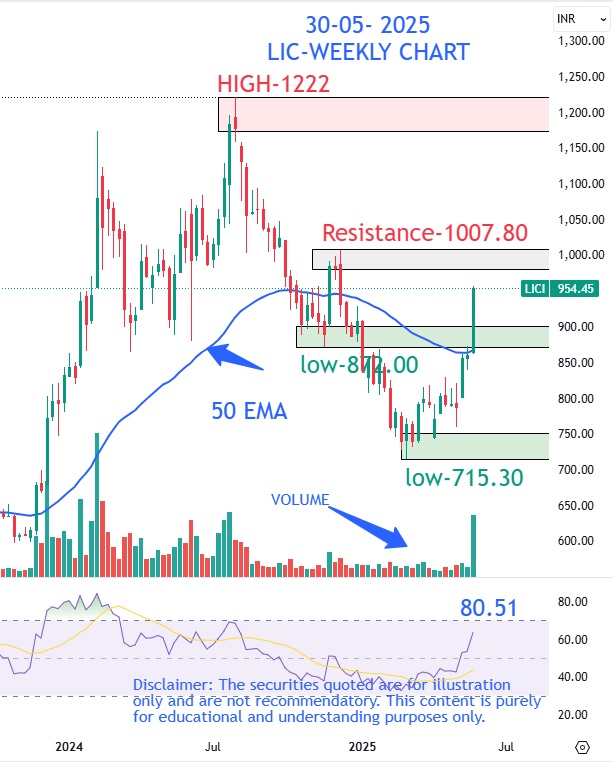
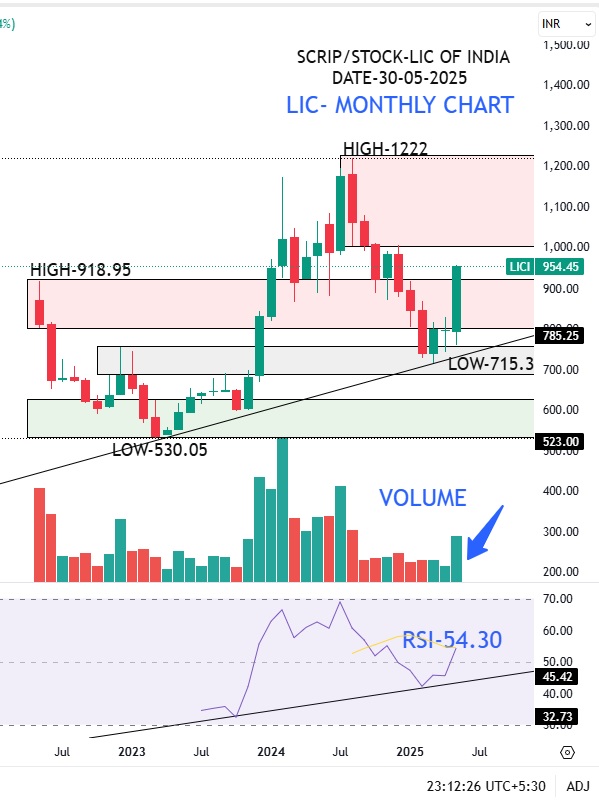
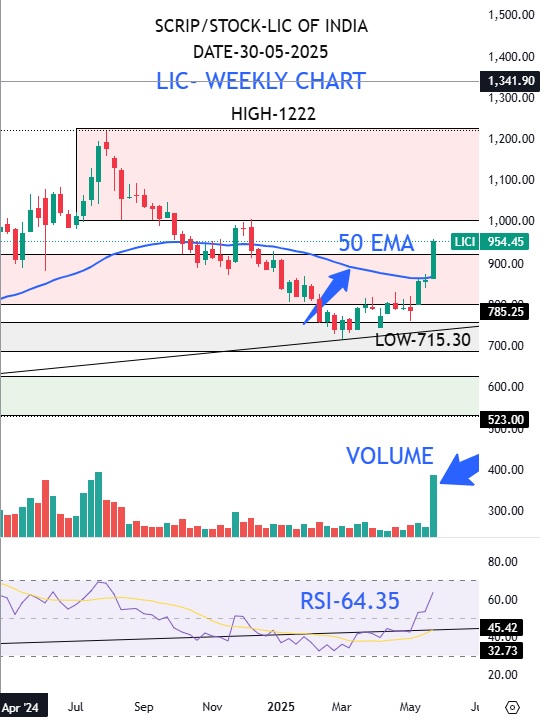
LIC Technical Analysis Checklist (Weekly Chart – 30 May 2025)
| Parameter | Observation |
|---|---|
| Trend | Strong bullish candle, breakout visible |
| 50 EMA Status | Price has broken above the 50 EMA |
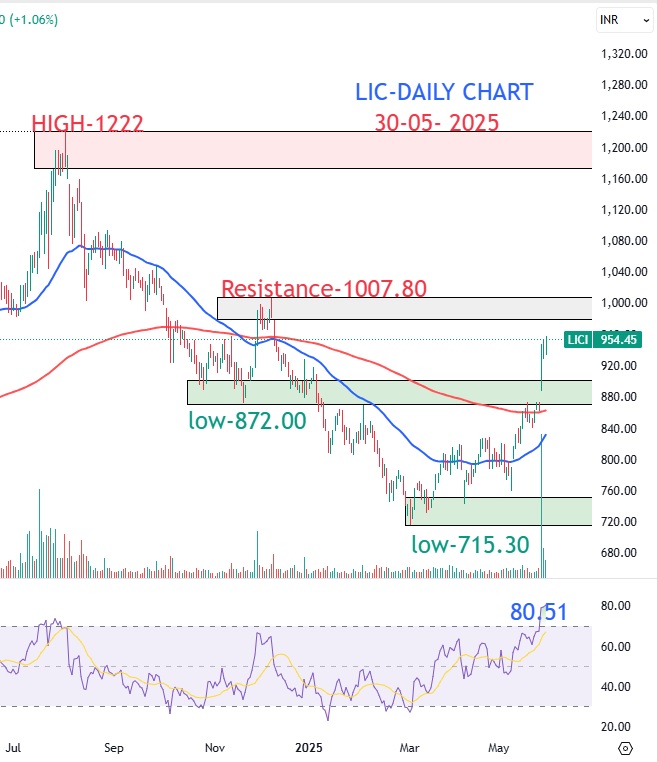
| Support Zones | Strong support around ₹871 and ₹715 |
| Resistance Ahead | Immediate resistance at ₹1007.80 |
| Volume Activity | Volume spike confirms the bullish breakout |
| RSI (Relative Strength Index) | RSI at 80.51 – Overbought zone |
| Trend Duration | Uptrend forming for the last 4 weeks |
| Price Structure | Higher lows – bullish price structure |
Summary:
- LIC’s weekly chart shows a strong bullish trend.
- Price has successfully broken above the 50 EMA, indicating strength.
- A spike in volume confirms that buyers are stepping in.
- RSI is at 80.51, which means the stock is overbought – a small pullback or consolidation is possible.
- Next resistance lies at ₹1007.80 – watch out for profit booking near that level.
What Should You Do?
- If you’re already invested: Hold your position; wait for a breakout above ₹1007.80 for further upside.
- If you’re looking to enter: A pullback towards ₹930–950 can be a better risk-reward entry.
- Stop-loss suggestion: Below ₹871 (key support zone
LIC Technical Indicator Summary (Weekly – 30 May 2025)
| Indicator | Observation | Signal / Comment |
|---|---|---|
| MACD (Moving Avg. Convergence Divergence) | Upward direction | Bullish Momentum Building |
| RSI (Relative Strength Index) | 42.85 | Neutral Zone (neither overbought nor oversold) |
| Stochastic Oscillator | PCO (Bullish Crossover) | Positive Momentum Indicated |
| 50 EMA (Exponential Moving Avg.) | Price trading above 50 EMA | Trend Reversal or Bullish Confirmation |
| Volume | Higher than average | Strong Participation / Breakout Validity |
| Candlestick Pattern | Large Green Bullish Candle | Strong Weekly Buying Pressure |
| Chart Pattern | Not explicitly formed | No major pattern, but trend appears positive |
Interpretation:
- Overall, technical indicators are tilting bullish for LIC on the weekly chart.
- Price above 50 EMA, strong bullish candle with volume, and MACD direction all support a positive near-term outlook.
- RSI being neutral suggests there’s still room for further upside without being overbought.
What’s Strong About LIC? (Strengths)
Market Cap – ₹6,03,784 Cr
A massive and trusted company. It’s India’s largest life insurance provider.
Market Cap = Share Price × Total Number of Shares
ROCE – 53.5%
These return ratios are excellent, showing efficient use of capital and equity.
ROCE tells us how efficiently a company is generating profit from its total capital (both debt and equity).
ROCE (Return on Capital Employed)
ROCE = (EBIT ÷ Capital Employed) × 100
Where:
Capital Employed = Total Assets – Current Liabilities
EBIT = Earnings Before Interest and Taxes
ROE – 46%
ROE = (Net Profit ÷ Shareholders’ Equity) × 100
Where:
Shareholders’ Equity = Total equity (owners’ capital in the company)
Net Profit = Profit after tax and all expenses
ROE shows how efficiently a company is generating returns on the shareholders’ funds.
Higher ROE means better profitability and financial performance from the investor’s point of view.
Debt to Equity – 0.00
LIC is completely debt-free, which is a big positive.
Debt to Equity Ratio = Total Debt ÷ Shareholders’ Equity
Why is LIC’s Debt to Equity Ratio 0.00?
LIC is an insurance company, and insurance companies usually operate using policyholder funds and premium income, not borrowed money.
So:
That’s why LIC’s Debt to Equity Ratio = 0.00, which indicates strong financial stability.
LIC has little or no debt.
What is an Ideal Debt to Equity Ratio?
- 0 to 1: Considered good – low debt risk
- Above 1: High debt – may be risky
- 0: No debt – very safe, but may limit aggressive growth
Ideal ratio depends on the industry:
- IT sector: 0.1 to 0.5 is healthy
- Infrastructure or Capital-Heavy sectors: Up to 1–2 is acceptable
- Insurance and Finance companies: May have zero debt — that’s normal
Promoter Holding – 96.5%
Strong government ownership adds a layer of trust and stability.
High promoter holding (above 75%) means strong control, but low liquidity. Ideal range is 50%–75% for balance.
In LIC’s Case:
As per SEBI rules, minimum public shareholding should be at least 25%, so LIC is expected to gradually reduce government holding over time.
96.5% promoter holding is because it was a government company, and only a small % has been offered to the public via IPO.
Why Very High Promoter Holding (like 96.5%) Can Be a Concern:
Positive: Shows strong confidence of the promoter in the company
Negative: Very low public shareholding can lead to low liquidity, less price discovery, and poor retail participation in the market
Low Valuation (P/E – 12.5, Price to Sales – 0.68)
Comparatively undervalued, great for value investors.
PE Ratio shows how much investors are willing to pay for ₹1 of a company’s earnings.
In simple words:
PE Ratio = Share Price ÷ Earnings Per Share (EPS)
PE Ratio at a Glance:
| PE Ratio | What It Indicates |
|---|---|
| Below 10 | Very cheap (Undervalued) |
| 10 – 25 | Fairly Valued (Normal range) |
| Above 25 | Expensive or High Growth |
PE Ratio tells you whether a stock is cheap or expensive compared to its earnings.
Price to Sales – 0.68
Price to Sales Ratio = Market Cap / Total Sales
It shows how much investors are paying for ₹1 of company’s sales.
P/S < 1 is considered undervalued (good for value investors).
LIC’s P/S of 0.68 means it’s likely undervalued.
What is a Good Price to Sales Ratio?
| P/S Ratio Range | What It Means | Good or Bad? |
|---|---|---|
| Below 1 | Undervalued | Good for value investors |
| 1 to 3 | Fairly valued | Neutral |
| Above 3 | Overvalued | Risky |
LIC’s P/S Ratio = 0.68
This means LIC is undervalued compared to its revenue, which is a positive sign for long-term investors.
Consistent Dividend – 1.06%
Offers stable passive income through annual dividends.
Dividend Yield tells you how much return (as a % of current share price) a company gives to shareholders in the form of dividends every year.
Dividend Yield = (Annual Dividend per Share ÷ Current Share Price) × 100
What is a Good Dividend Yield?
| Dividend Yield | Interpretation |
|---|---|
| 0% – 1% | Very low – maybe growth-focused company |
| 1% – 3% | Average – common in large, stable companies |
| 3% – 6% | Good – attractive for income-seeking investors |
| Above 6% | High – may indicate undervaluation or risk |
What Are LIC’s Weaknesses? (Risk Factors)
Very Low Public Holding (2.13%)
Low liquidity in the market, may result in low trading volume.
| public holding (%) | what it indicates | good or risky? |
|---|---|---|
| 0% – 5% | very low – most control lies with promoters or the government | low liquidity, less transparency |
| 5% – 15% | limited – some room for institutional/fii investment | stable but limited trading |
| 15% – 35% | balanced – healthy public participation | good balance and visibility |
| 35% – 50%+ | high – actively traded, more public interest | great liquidity and price action |
LIC Public Holding = 2.13%
- This is very low, which means most of LIC’s shares are held by the Government or Promoters.
- Low public holding often results in low daily trading volume and less retail participation.
- It also means fewer shares are available in the open market, making the stock more volatile during high demand.
Price to Book Value – 4.73
Slightly expensive in terms of book value multiples.
What is Price to Book Value (P/B Ratio)?
| Term | Meaning |
|---|---|
| Book Value | Company’s total assets minus liabilities (Net worth of the company) |
| Market Price | Current price of one share in the stock market |
| P/B Ratio Formula | Market Price per Share ÷ Book Value per Share |
P/B Ratio Interpretation
| P/B Ratio | What it Means | Investor View |
|---|---|---|
| Less than 1 | Stock is trading below book value | Undervalued (may be a bargain) |
| Around 1 | Stock is trading close to its actual book value | Fairly Valued |
| More than 1 | Stock is trading above its book value | Overvalued or High Growth Expectations |
P/B = 4.73
| Parameter | Value | Interpretation |
|---|---|---|
| P/B Ratio | 4.73 | The stock is priced at 4.73 times its book value |
| Market Sentiment | Expensive | Investors are paying more than the actual net worth per share |
| Possible Reasons | Strong growth, brand value, future earnings potential, or market hype |
Moderate Growth
Sales growth is only 5.2%, not a fast-growing company.
- Moderate Growth means the company is growing, but not very fast.
- In this case, sales (revenue) has grown by only 5.2% compared to the previous period (usually year-on-year).
- This percentage is not considered high for fast-growing companies, especially in competitive industries.
- So, it means the company is stable but not aggressively expanding.
Table Format:
| Term | Meaning |
|---|---|
| Sales Growth | Increase in total sales/revenue over a period |
| Growth % | 5.2% |
| Interpretation | Moderate growth; not very impressive, but also not declining |
| Investor View | Suitable for stable or long-term investing, not for high growth returns |
Complex Business Model
The insurance business is technically complex. Understanding policy mix, yield assumptions, and actuarial reports may be difficult for retail investors.
Should You Invest in LIC?
Yes, if you are…
- A long-term investor (3–5+ years)
- Looking for a safe, government-backed stock
- Prefer steady growth + regular dividends
LIC could be a great option for you.
Avoid if you are…
- Seeking high-growth, multi-bagger returns
- Expecting rapid price appreciation in the short term
LIC is a slow-moving but stable stock.
Conclusion:
LIC is a fundamentally strong, undervalued, and trustworthy company, but not a “quick returns” stock.
It is ideal for long-term SIP-style investments or as a core holding in a conservative portfolio.
What does a high P/B Ratio of 4.73 indicate?
It shows the stock is priced higher than its actual book value, possibly indicating overvaluation or strong future expectations.
Why is 5.2% sales growth considered moderate?
Because it reflects slow revenue growth, not typical of a fast-growing company.
Read More
Yes Bank and SMBC Deal 2025: Profits, Stake and Future Plans

Disclaimer: All content shared by STOCK OVERVIEW is purely for educational and informational purposes. We do not provide any investment advice or recommendations. Always seek guidance from a qualified financial advisor before making any trading or investment decisions. We are not liable for any financial gains or losses based on the information shared.
The securities quoted are for illustration purposes only and are not recommendatory. Chart reading is explained here only for knowledge purposes — to help you understand how to interpret financial data.

Welcome to Stock Overview! Expand your knowledge about the stock market and invest smarter. I started this channel to help everyone understand the basics of the stock market. When you meet a SEBI-registered advisor or a mutual fund distributor, you should be able to understand their suggestions clearly. This is only possible when you’ve done your minimum homework from your side. My goal is to empower you to make informed financial decisions confidently.
Contents
- 1 Who Regulates LIC? Meet IRDAI – The Insurance Regulator of India
- 2 LIC’s Latest AUM
- 3 What is Market Capitalization (Market Cap)?
- 4 Comparison: AUM vs Market Cap
- 5 LIC Fundamental Analysis Checklist (As of May 2025)
- 6 Technical Analysis (2025) Checklist
- 7 LIC Technical Indicator Summary (Weekly – 30 May 2025)
- 8 What’s Strong About LIC? (Strengths)
- 9 What Are LIC’s Weaknesses? (Risk Factors)
- 10 Should You Invest in LIC?